
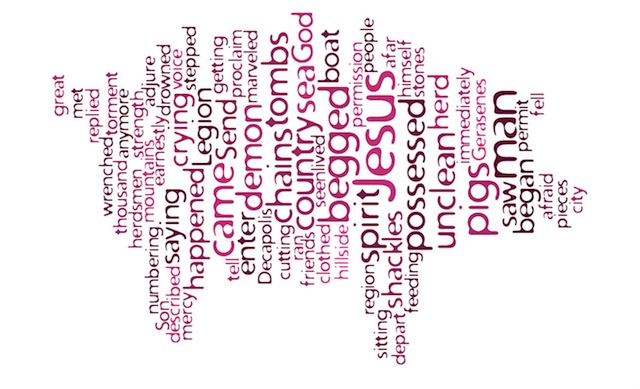
Jesus is in command over the spiritual realm (Mark 5:1–20)

In any good summer blockbuster movie, our intrepid hero stares down overwhelming opposition in a final showdown. Vastly outnumbered, he relies on his wits and skill to emerge victorious from the battle. We cheer him on because we love to see the good guy win, especially if he’s the underdog.

It’s a little different in Jesus’ case. He’s about to be vastly outnumbered by the enemy, but it doesn’t even faze him. Jesus is not the underdog; he is never the underdog. But he likes to help people who are underdogs.

Immediately following the terrific windstorm from the night before, Jesus and his followers reach land on the other side of the Sea of Galilee. This region is inhabited by the Gerasenes, who were Gentiles. It’s the first time in Mark’s gospel that Jesus ventures into Gentile territory. As soon as he steps onto the land, he is confronted by a powerful foe.

A man rushes down the beach to meet him, and he isn’t coming with friendly intent. He is a wild beast of a man, an unclean Gentile, controlled by an unclean spirit, living among unclean tombs. No one can tame him and chain him down; the unclean spirit gives him phenomenal strength to break his bonds. But now we see this monster falling down on the beach before Jesus, shrieking, “What have you to do with me, Jesus, Son of the Most High God? I adjure you by God, do not torment me.” In other words, he is pleading with Jesus, “Leave me alone!” Why? Because Jesus had begun to confront the spirit controlling the man, saying, “Come out of the man, you unclean spirit!” It’s a showdown between spiritual forces, and there’s no question who is going to win.

Then the big reveal takes place. Jesus ignores the man and confronts the unclean spirit inside him, demanding, “What is your name?” And the spirit replies, “My name is Legion, for we are many.” A legion was a roman army unit comprised of 6,000 men; it represented a force of astounding size. There were innumerable demons oppressing this man—but they are reduced to begging Jesus for mercy. They beg him to let them stay in the country and enter a herd of (unclean) pigs; Jesus gives them permission. This is an act of defiance on the part of these spirits; they have been embarrassed and want to save face by demonstrating their power. They represent such an overwhelming force that, in their fury, they are able to drown the entire herd of 2,000 pigs into the lake like so many lemmings.

When the pig herdsmen witness this incredible show of force, they run to tell the news to whomever will listen. Those who hear it run to see it for themselves, and there they find Jesus—and the demon-possessed man, sitting there calmly, “clothed and in his right mind.” And then, Mark tells us, “They were afraid.” They know that these spirits have tremendous power; the spirits had turned this man into an untamable beast, and they had just driven a massive herd of pigs to their death. Yet Jesus had dismissed them all with a simple command. These spirits were frightening enough—how much more so the man who mastered them!

But here’s the thing about fear: it doesn’t guarantee faith. As the legion of spirits begged Jesus, so now the people beg him for a favor as well—“to depart from their region.” Why? Because Jesus is a threat to them. When someone with this power shows up, he changes the status quo. That’s great news to people who are outcast or oppressed, like the demon-possessed man. But it’s bad news for people like the herdsmen, who have nothing to gain when the King comes to exercise his authority. If Jesus is in command over the spiritual realm, there is no stopping him. So they plead with him to leave, and Jesus obliges them.

As for the demon-possessed man, he too begs Jesus for a favor. He asks “that he might be with him.” This is what Jesus had asked his disciples to do (3:14). So will he grant the man’s request, just as he had granted the request of the unclean spirits and the request of the man’s Gerasene countrymen? Strangely, he does not. He has a better plan for his new recruit: “Go home to your friends and tell them how much the Lord has done for you, and how he has had mercy on you.”

If you’ve been following along for the first four chapters of Mark, this order should surprise you. Jesus has repeatedly tried to hide himself and his message, ordering unclean spirits and a cleansed leper to keep quiet about him, and speaking in parables to conceal the good news of God’s kingdom. As we keep reading in Mark, we will find that he continues to value secrecy. But here, he orders the man to tell everyone about what had happened. Why?

Take a look at what Jesus asks the man to say. “Tell them how much the Lord has done for you, and how he has had mercy on you.” That’s all. The message the man is to deliver is simply this: the Most High God of the Jews has come to deal kindly with the Gentiles. This demoniac was an unclean man among unclean men. If Jesus feels compassion for him and rescues him, how much more will he do so for his countrymen! The man travels throughout the region, telling how much Jesus has done for him, and everyone marvels over the news.

We saw last week that Jesus had authority over the natural world, and now we see that he has command over the spiritual realm. And once again, he uses that authority with a meekness, a gentleness, a pity for the outcast and the oppressed. A madman in agony, loneliness, and despair—now clothed and in his right mind and jubilant with news of a great Savior.
Jesus possesses fearsome authority (Mark 4:35–41)

A couple of winters ago, I was taking my car around a corner when it slid on a patch of ice. In a stunned, this-can’t-be-happening moment, I felt my car careen toward another parked vehicle and strike it with a solid thud. Amazingly, no damage was done—our cars were both coated in ice, so not even the paint was scratched! Yet I was so rattled by the accident that I refused to drive my car for the rest of the day. Ever since, I have been far more cautious when turning a corner on an icy winter day.

Have you ever experienced an event that rattled you so much that it altered the way you react to the situations you face in life? For the first time, Jesus’ disciples are about to experience that feeling when they realize that they have underestimated this Galilean rabbi.

After a day of preaching in parables to his vast audience, Jesus decides it’s time to move on to the other side of the Sea of Galilee. So he and his disciples set out across the lake in a flotilla of fishing boats. Unfortunately, they are caught in the middle of the lake by a terrific windstorm which whips up massive waves that threaten to sink the vessels. Many of the disciples on Jesus’ boat were probably fishermen, and they knew all too well how deadly these storms could be. They could see that the boat was filling with water, that they couldn’t bail it out fast enough, that their death was inevitable. And just a few hours ago they had been basking in the attention of their rabbi and the adulation of the crowds!

At some point in their growing panic, some of Jesus’ disciples notice that he is in the stern—and that he is fast asleep. Unbelievable! They wake him up and shout, “Teacher, do you not care that we are perishing?” That’s the only possible explanation for why he is asleep. Jesus seems so callous toward their very survival.

Ignoring their question, Jesus gets on his feet and shouts to the wind and the waves roaring around him, “Peace! Be still!” He rebukes them, just as he has rebuked the unclean spirits. And then—“the wind ceased, and there was a great calm.” And just as the demons did, the forces of nature obey him. I like to picture the storm clouds dissipating, leaving the reflections of stars in the smooth mirror of the lake. Little ripples spread out from the boat as it bobs up and down in the water. There is no sign of a storm, not a sound. The disciples are dumbstruck. After a moment’s silence, Jesus turns to them.

“Why are you so cowardly? Have you still no faith?”

Most translations have Jesus accusing the disciples of being “afraid,” but actually he is more frank than that. He calls them cowards. Their panic was unreasonable and unacceptable.

I don’t know about you, but I tend to sympathize with the disciples here. I can see why they would be afraid. The storm is too powerful; the waves are too great; their boat is too small. That’s not how Jesus sees it, though. He knows he has authority over the forces of nature. They can’t do a thing that he doesn’t permit. No need to interrupt his nap.

The disciples don’t perceive Jesus’ power, so they question his love. They doubt him. And because they doubt both his love for them and his power to save them, they become cowards. If you want to become a coward, this is the quickest way.

When Jesus intervenes with a miracle, their cowardice is replaced not with confidence but with “great fear.” When a great storm is replaced with a great calm, they are filled with great fear. The windstorm was tremendously dangerous; how much more so the man who has authority over the storm! “Who then is this?” they ask.

God often uses fear to unsettle us. The disciples didn’t seem to fathom that Jesus was anything more than a great teacher and miracle worker. Perhaps they may have entertained the notion that he was something more. But now, burning in their souls, is the reality that they don’t have a clue who Jesus really is. New questions are forming in their minds, questions whose answers will lead them to faith.

Jesus’ challenge to his disciples is essentially this: “Do you trust me?” By their actions, they show that they don’t—not yet. They need to see his fearsome authority over the wind and the sea. They need to know that he is more than a man. This is the cure for doubt and cowardice—to see Jesus Christ as trustworthy. You are weak; you are at the mercy of powerful forces that will crush you. But Jesus is strong. Don’t underestimate him.

When forgiveness gets offensive (Mark 2:1–12)

Jesus doesn’t mind offending people. Each one of the gospel writers includes a first incident where he begins to tick off some of the people who have liked him up to that point. In every case, it comes fairly early in his ministry. In Luke, this happens when he preaches at his hometown of Nazareth, explaining that the Gentiles will accept him before his fellow villagers will (4:16–30). In John, people get angry at Jesus when he brandishes a whip in the temple courtyard and drives out a group of merchants and money-changers (2:13–22). However, in Matthew and Mark, the pivotal incident takes place inside a little house in the Galilean village of Capernaum.

Up till now, Jesus has been doing all the right things. He’s been teaching with a unique authority; he’s cast out demons; he’s healed people who are sick. These are great credentials for a Messiah figure. Now, however, Jesus is going to make the religious leaders of the day really uncomfortable really fast. He’s going to begin claiming authority for himself that doesn’t fit into their ideas of what the Messiah ought to be like.

» Read Mark 2:1–12

The day begins innocently enough, with Jesus returning to Capernaum and stays at a nice, spacious house. Someone rats him out, and before long the crowd descends on him, filling up the house to the point where no one can get in anymore. Then, four men arrive, carrying their paralyzed friend on a cot; they believe Jesus can heal their friend. Since they can’t get in through the door, they take the stairs up top and proceed to “de-roof” the roof. No doubt this created quite the scene inside the house; amid all the dust and chaos and falling chunks of roof, a paralyzed man descends on a cot, lowered by ropes.

Jesus is impressed. These men (and presumably their paralyzed friend) have a lot of faith that Jesus can help them. They trust Jesus so much that they are willing to try something totally crazy in order to get to him. Jesus really likes people with creative, daring, and disruptive faith. So he announces to the man, “My son, your sins are forgiven.”

In the words of Keanu Reeves:  Whoa.

I’m sure that’s pretty much the last thing that anyone standing there expected to hear. It’s not obvious why Jesus says this; did the man’s sins contribute to his paralysis? In any case, the first priority to Jesus is that this man be made right with God. What really ticks off the religious teachers standing nearby is that Jesus thinks he has the authority to pronounce God’s forgiveness. “He is blaspheming!” they think. “Who can forgive sins but God alone?” And they’re right about that second part. In every sin, God is ultimately the offended party; every sin is an act of insurrection against him. He is the King, so he makes the laws; when we break those laws, we reject him as King. And here we have Jesus thinking that he gets to forgive those sins. No mere man can do that—not even a man as great as the Messiah!

I love Jesus’ response. He doesn’t back down. Instead, he turns on his X-ray vision and reads their minds. Yeah, he can do that. Then, he poses a bit of a riddle for them. “Which is easier, to say to the paralytic, ‘Your sins are forgiven,’ or to say, ‘Rise, take up your bed and walk’?” What a clever set-up! On the one hand, it’s easier to say, “Your sins are forgiven,” because it’s not something that can be tested; if you say, “Rise, take up your bed and walk,” people are going to figure out pretty fast whether you have that sort of authority or not. On the other hand, fixing a paralyzed man’s legs is small beans compared to forgiving his immense, grave sins against a colossal, holy God.

So Jesus plays the trump card and does both! He heals the paralyzed man, telling the religious teachers that he’s doing it “that you may know that the Son of Man has authority on earth to forgive sins.” This is the first time in Mark that Jesus identifies himself as the Son of Man—a veiled reference to the messianic figure of Daniel 7:13–14. The Son of Man has been granted authority by God to set up an eternal, universal, indestructible kingdom. And now, Jesus just proved that you can’t underestimate the authority of the Son of Man. He can do things that only God can do. So it’s only natural that the people in the crowd “were all amazed and glorified God, saying, ‘We never saw anything like this!’” No, I’ll bet you haven’t. It’s not every day that the King of all the universe shows up in your town.

We don’t know yet how the religious teachers are going to respond to this smack down. But one thing is clear—Jesus isn’t afraid to claim immense authority for himself. He isn’t afraid to wield that authority by forgiving people who trust him. He isn’t afraid to humble anyone who challenges him. He isn’t afraid to flex his muscles. And this won’t be the last time he does.

Teaching with authority (Mark 1:16–31)

“Don’t tell me what I can and can’t do.” “You can’t push your morality on me.” “You have no right to order me around.”

We just don’t like authority here in the West. In an increasingly cynical and postmodern culture, people in authority are eyed with suspicion. Authority threatens our sense of autonomy. Even in the church, the role of authority has been questioned—to the point where the bestselling Christian novel, The Shack, has denounced authority as inherently evil. We just don’t like the idea that someone can waltz into our lives and demand that we drop everything and do what he commands.

Maybe that’s part of the reason we have such a big problem following Jesus. He is not afraid to insist on his own authority.

Take a look at today’s passage in Mark. The first scene opens with Jesus walking along the shore of the Sea of Galilee, a deep lake known for its excellent fishing. He sees two sets of fishermen working the family business, calls to them and commands them to follow him, and they obey. Mark doesn’t really get into the backstory of these men (though John’s gospel explains that they already knew who Jesus was). Mark simply offers us a scene so abrupt, so startling, that we are left wondering, “What man possesses authority so great that he simply asks a handful of fisherman to leave their lifelong family business in order to follow him around?” Jewish Rabbis didn’t seek out followers; their followers sought them. Yet here is Jesus, walking up to these men and staking his claim on their lives. As far as he was concerned, they belonged to him. He owned them.

Do you find that last sentence a little threatening? I’m an American citizen, and odds are that you are as well. We like to think we’re free; we like to think that nobody has the right to order us around. The problem is, Jesus has that right. “Follow me,” he insists, “and I will make you become fishers of men.” There is a threatening beauty to Jesus’ statement: it is a command followed by a promise. To men who have no greater ambition than to make money and pass on the family occupation, Jesus offers something far greater. “You won’t be fishing for fish anymore. No, I will turn you into someone who fishes for people. The gospel of the kingdom that you’ve heard me proclaim is the gospel that you will proclaim.” Jesus gives them a new destiny, providing a sense of meaning and purpose to their lives that they have never had before.

So what do Simon, Andrew, James, and John do? Jesus says, “Follow,” so they follow. They leave their jobs and their families and obey him at once. That’s the sort of authority Jesus has.

With his disciples in tow, Jesus shows up in the town of Capernaum along the seashore. He arrives in the local synagogue on the Sabbath day and is invited to teach. When he does, he astonishes everyone there because he teaches them with authority, “and not as the scribes.” The scribes were the local teachers of the law, who would simply parrot what other teachers had said about the Old Testament. Not Jesus! He steps up and teaches his own ideas, and he teaches them with the air of someone who is perfectly within his rights to order you around.

However, there is someone in attendance who doesn’t want to be ordered around. A man with an “unclean spirit”—a demon—tries to shout Jesus down. He wants to shut down Jesus’ teaching, so he instigates a confrontation, shrieking, “What have you to do with us, Jesus of Nazareth? Have you come to destroy us? I know who you are—the Holy One of God.” The unclean spirit is attempting to wrest control of the situation from Jesus. He goes on the offensive with three statements. First, he demands that Jesus leave him and his demonic comrades alone. Second, he announces that he knows Jesus’ plan—to destroy him and his fellow spirits, who have been harassing the people of Galilee. Third, he knows Jesus’ secret identity. He is “the Holy One of God”—someone with a special relationship with God, if not the Messiah himself! The unclean spirit pulls out all the stops to gain control over Jesus.

Jesus will have none of it. “Be silent, and come out of him!” he demands. Jesus had been teaching, the spirit had tried to shout him down, and now Jesus shuts up the spirit. This demon leaves the man with one final act of defiance, “crying out with a loud voice.” And then—silence. Jesus has the stage to himself. The crowd is astounded—this is a man of impossible authority! And notice the emphasis in the text: “a new teaching with authority”! Jesus’ victory over the unclean spirit demonstrates that his teaching really does have authority. Jesus really does have the right to tell you and me what to do. He’s not afraid to use that right. He owns us.

But the next scene shows the beauty of this authority. After that day’s incredible encounter in the synagogue, Jesus spends the afternoon at Simon’s house. While he is there, his disciples tell him that Simon’s mother-in-law is sick with a fever. Here, we find the first act of faith in Mark’s gospel. The disciples see that Jesus had the authority to drive out an unclean spirit. Maybe he has enough authority to heal her from this dangerous fever! They ask Jesus if he will do something about it.

Think about this. Here is a man with an authority they have never witnessed before. They have no right to demand him to perform a miracle of healing. He is perfectly within his rights to refuse them. Yet Jesus approaches the bed, takes the woman by the hand, and lifts her up. The fever leaves her, and she is finally able to show hospitality to her guests. Jesus wasn’t forced to heal her—he chose to heal her. He uses his authority for our good. He wants to heal us; he wants to free us; he wants to give us a new destiny.

Yes, his authority threatens us. And it’s a lovely sort of threat.

Mightier than I (Mark 1:2–13)

It’s been a cold winter here in Indiana. After last winter, in which the windchill dropped to around –30° F at times, I figured we were due for something a little warmer this time around. It’s true that November and December were unseasonably warm, and it’s true that temperatures have not dropped as low as last winter. However, early this January, the weather stayed cold for long periods of time with no respite. I’m just grateful for a warm house to come home to every day.

It’s times like this that I’m glad I don’t live in the wilderness. That word—wilderness—implies a harsh environment barely able to sustain human life. A winter like this makes everything a wilderness. The other way to make a wilderness is to cover a land with rocks, sand, and scorching heat. Take away any water, and you’ve got yourself the kind of place where no one would want to live. The only people found there are nomads and outcasts. Those who are rich and powerful stay away from the wilderness.

So what’s Jesus doing there?

» Read Mark 1:2–13

Unlike Matthew and Luke, Mark doesn’t begin his story with the birth of Christ. He has another way of telling the humble beginnings of Jesus. Mark’s “Christmas story” begins in the Judean wilderness—a wasteland of hills, hot sun, dust, and precious little water. It’s not a coincidence that Jesus shows up here; his coming was prophesied in the Old Testament by Isaiah and by Malachi. In verses 2–3, Mark quotes Malachi 3:1 and Isaiah 40:3, which together reveal that a messenger will herald the Messiah’s coming. This messenger will call for a highway to be carved into the impassable hills—a highway broad, flat, and straight, fit for a King. This King will make his entrance into the world through the wilderness. Who is this King? Well, in a clever little trick, Mark adjusts and clarifies Malachi’s prophecy. Malachi quoted God as saying, “I send my messenger and he will prepare the way before me.” In Mark, we read him to say, “I send my messenger before your face.” So is the messenger preparing the way for “me”—for God? Or is he preparing the way for “you”—for Jesus? Or could it be…?

With a sly smile, Mark moves on with his story.

In the wilderness, a place where the powerless live, the messenger John explains that this “highway” is really the repentance of God’s people, signified by baptism. If they repent—if they change their attitude and their behavior—they will be forgiven for their sins. But that is not all. John, dressed like a prophet, announces that this forgiveness is only the beginning. “After me,” he declares, “comes he who is mightier than I.” This mightier man will immerse his people in the Holy Spirit. He will soften their hearts and empower them to follow the Lord faithfully (Ezekiel 36:26–27).

Mark doesn’t leave us waiting. The mightier man comes from Nazareth in Galilee to be baptized. Now, everyone else who had been baptized would confess their sins and repent. Not Jesus. When he comes up from the water, heaven is opened, and the Spirit descends on him “like a dove” (verse 10). Then comes a voice from heaven: “You are my beloved Son; with you I am well pleased.”

Imagine, for a moment, if this had not happened. If Jesus’ baptism had gone the way all of John’s other baptisms had gone, people would assume that he was just like everyone else. He would be seen as a fellow sinner looking for a Messiah. But when God speaks from heaven, he identifies him as his special Son, as someone he dearly loves, as someone who has pleased him in every way. Mark doesn’t say it outright, but he once again hints to us, “This man is not looking for the Messiah. He is the Messiah.” Unlike any other man, Jesus is fully pleasing to God; he has not earned God’s wrath for sin.

The greatest outpouring of God’s wrath in the Old Testament was the great Flood of Noah (Genesis 6–8). The heavens were opened, and the whole world was immersed in waters of judgment. At the end of the Flood, Noah sent out a dove three times to see if there was any dry land left. The third time he did this, the dove did not return. The water had subsided, and Noah knew that God’s wrath had come to an end. Here in Mark’s story, Jesus is immersed in water, but he is not condemned. When the heavens open, there is no wrath. The Spirit descends on him in the form of a dove, and God announces that he is fully pleased with this man. In Jesus, and only in Jesus, there is peace with God.

The Holy Spirit descends on Jesus and drives him again into the wilderness. With Jesus, the mightier one, everything takes place on a colossal scale. Almost in passing, Mark mentions that he stays in the wilderness 40 days, is tempted by Satan, that he lives among wild animals, and that he is served by angels. No big deal. Just another event in the life of Jesus. The Spirit drives him to do great things, until even the great things can only be mentioned briefly.

This sort of understated power and authority is so characteristic of Jesus in Mark’s gospel. And it comes with a promise. The last words that John speaks in this gospel are these: “He will baptize you with the Holy Spirit.” Jesus is so mighty that he has authority over the Holy Spirit. He can change people’s hearts; he can take cynical, calloused, bitter people and make them trust him, love him, and worship him. He can take fearful people and make them into heroes of the faith, able to stand against Satan and wild animals, heroes to whom angels minister.

Yes, he can change you.