
From day to day I postponed life in You, but I did not postpone the death that daily I was dying in myself. I was in love with the idea of happiness, yet I feared it where it was, and fled away from it in my search for it.
Category: Uncategorized
Jesus has come to announce judgment, but it won’t come right away (Mark 13:3–13)
 It’s Chicken Little vs. Jesus in this next compelling installment of Mark’s gospel!
In the first two verses of this chapter, Jesus has announced that the Jewish temple will be destroyed because its leadership has rejected him as the Messiah that God has sent to lead his people. Naturally, his disciples now want to know all about this impending judgment. So his inner circle of Peter, James, and John (plus Peter’s kid brother Andrew) come up to him and ask him, “Tell us, when will these things be, and what will be the sign when all these things are about to be accomplished?”
The rest of chapter 13 is Jesus’ response to these two questions. It’s a very difficult chapter to interpret. Much of what Jesus says seems to apply to the destruction of the temple in 70 A.D., a mere 37 years later. Following a Jewish revolt, the Roman government sent an army to crush the rebellion and return Palestine to its status as a province of Rome. The army laid siege to Jerusalem, slaughtered the people, and flattened the temple. By the time that the Romans were finished, the Jewish nation had been crushed.
However, as we work through this chapter, we will see some statements Jesus makes that don’t quite fit the historical events that took place. They seem to describe judgment on a grander scale. This might surprise you or cause you to question whether Jesus prophesied accurately. However, this is part of a pattern in the Bible which you see in Old Testament prophecies. The prophets would announce that God was about to judge the nations threatening his people (or sometimes his people themselves!) while promising salvation for the remnant of his people who remained faithful to him. This divinely appointed judgment was often referred to as the Day of the Lord. And sometimes, the prophet would see beyond this immediate judgment to the ultimate Day of the Lord that will come on all the earth. God works in patterns in human history, and the Day of the Lord is one of those patterns. This is why the prophet Joel, for example, could warn about an impending plague of locusts and call it “the Day of the LORD” (2:1), yet use language that is picked up by Jesus to describe the coming judgment of God (Joel 2:10–11 and 2:30–31; compare Mark 13:24–25). The locust plague was one of many sneak previews of a future judgment coming on all the earth.
Now, when the disciples ask Jesus about the coming judgment on the temple, they probably think that this will mark the final judgment of the whole world. They think that at this point Jesus will set up his kingdom on earth (Mark 10:36; Acts 1:6). That’s probably what they mean when they ask about “these things.” They’re asking, “When will the temple be destroyed and your kingdom set up in its place?” Because the establishment of Christ’s kingdom is a far more complicated process than they think, what they’ve asked is a far more complicated question than they think. And thus Jesus’ answer is complicated as well. The destruction of the temple in 70 A.D. becomes a preview of the great worldwide judgment when the kingdom arrives “on earth as it is in heaven” (Matthew 6:10).
Now, if it were me in Jesus’ place, I might respond by laying out a nice neat timeline of “last days” events. Maybe I’d draw a chart in the dirt for them. But that’s not what Jesus does, because Jesus knows we don’t really need an end-time chart. What his disciples need is to live faithfully in this present age while they wait for God’s judgment to arrive and bring justice on the earth.
So the first thing that Jesus tells his disciples is, “See to it that no one leads you astray.” He’s concerned that the questions the disciples are asking might turn into obsessions. They might be deceived by people claiming to be the returning Christ. They might interpret wars and disasters to be signs of the end. If you’ve ever tuned into religious broadcasting or read any bestselling “end times” novels, then you probably know that Jesus’ fears are justified. There is an unhealthy obsession with plotting out end-time charts and trying to force current events to fit into biblical prophecies. Jesus says not to be alarmed when you hear Chicken Littles shout, “The sky is falling!” He says, “These are but the beginning of the birth pains.” The baby isn’t here just because the water broke, as many a mother can tell you. There’s a lot more to come before the end, and it won’t be pretty.
And just like a mother whose labor has become, Jesus’ disciples can’t expect to get away without suffering. Some end-time teachers emphasize that God’s people shouldn’t have to suffer—they will be “raptured” away from the earth before God’s judgment begins and so will escape “tribulation.” In contrast, Jesus warns us not to relax in our easy chairs. “Be on your guard,” he warns. In every age, Christians will be persecuted by everyone from hostile governments to close family members. “You will be hated by all for my name’s sake,” Jesus says. Then he promises, “But the one who endures to the end will be saved.” The mark of a genuine Christian is endurance. When your faith is challenged, it becomes obvious what you really believe.
You and I want Jesus to give a timeline of the end. But Jesus is much more concerned at how his disciples live in the present, before God’s judgment arrives. The end won’t come right away, so the question is whether we will remain faithful to him in the world as it now exists. Will you get carried away by apocalyptic fantasies? Will you buckle under hostility from family or authority figures? Or will you remain sober-minded and faithful to the end?
Eight years of “goodbye”
Two weeks ago, I left behind the town of Lafayette, Indiana. I lived there for more than eight years, which is the longest span of time I’ve lived in one town or city. It was the closest I’ve come to calling a town my own.
The land shall not be sold in perpetuity, for the land is mine. For you are strangers and sojourners with me.
—Leviticus 25:23
What always held me back from feeling settled in Lafayette was the fact that it is such a transitional town. When I left, several people in my church commented that it was hard to imagine the church without me. They had arrived later, and as far as they were concerned, I had been around forever. I was the permanent one—possessing eight years of permanence!
You can’t shake that unsettled feeling when you live in a town like that. You know that you are a sojourner. You can’t fool yourself into believing you’ll be there forever.
In the Old Testament, as Israel was preparing to move into the promised land of Canaan, the Lord instituted a series of laws about how they were to treat the land. They were not to overwork it or sell it permanently because the land was his, not theirs. They were tenants; he was the landlord. He was their host; they were his guests.
For we are strangers before you and sojourners, as all our fathers were. Our days on the earth are like a shadow, and there is no abiding.
—1 Chronicles 29:15
 When you’re a stranger and a sojourner, you feel your impermanence on a visceral level. You could disappear, and the world could go on just fine without you. You flit about like a phantom, a shadow, moving from place to place, with no substance.
When I moved away, I had many people come to me to wish me well and to say goodbye. It was hard for me to say goodbye—not because the separation was too painful but because it was perhaps too easy. Most of these friends I will be able to keep up with on Facebook, after all. There will be few severed relationships.
And this was not the first time I’d had to say goodbye. The fact is that it was simply the conclusion to eight years of goodbyes. When you live in Lafayette, people come and go every year. They pass like phantoms through the town, taking classes or working a temporary job until career or family draws them away. You make friends, then let them go, then make new friends, then watch them leave as well. And when it comes time for you yourself to leave, it is not your closest friends who have remained to see you off. So “goodbye” is not as hard, because it’s fundamentally no different from any of the others.
O LORD, make me know my end
and what is the measure of my days;
let me know how fleeting I am!
Behold, you have made my days a few handbreadths,
and my lifetime is as nothing before you.
Surely all mankind stands as a mere breath! Selah
—Psalm 39:4–5
Here in the West, we do our best to quarantine death, to hide it away in hospitals and nursing homes, to pretend that we will live forever. We do our best to make this world a heaven, to live in a nice neighborhood and own a shiny car and find a purposeful career. But this requires a lot of transience and rootlessness, a lot of moving around. So even though we can postpone the death of our bodies, we cannot avoid the isolation of lost friendships. Our impermanence is more obvious than ever.
Hear my prayer, O LORD,
and give ear to my cry;
hold not your peace at my tears!
For I am a sojourner with you,
a guest, like all my fathers.
—Psalm 39:12
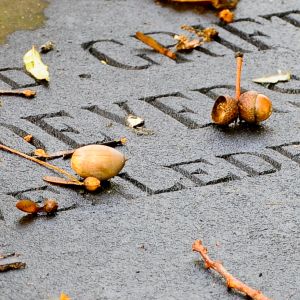 The earth is the Lord’s. I’m just passing through. I am a sojourner here, a guest of the Lord’s, just like my father was, and his father before him—a man who did not last long enough for me to meet him. There is no hope to be found in our relationships with one another. Hope must be anchored to an immovable object; I can’t find hope in my relationships with other people any more than a ship at sea can anchor itself to the wind and fog.
Who does David, king of Israel, appeal to in Psalm 39? He appeals to the one who created the land on which he is kneeling, the one who owns it and will continue to own it thousands of years after David vanishes from the earth. The Lord is the only permanent mooring in a world of passing shadows.
So may you cling to the Rock which will outlast the world. And may you find eternal life by binding yourself to our eternal God.
Jesus has come to announce judgment, so don’t be impressed with human establishments (Mark 13:1–2)
I read J. R. R. Tolkien’s The Lord of the Rings trilogy back in high school, but I never really got sucked in by them the way a few of my friends did. I enjoyed the movies, though, despite the fact that one of the characters in The Return of the King creeped me out. This was Denethor, the Steward of Gondor, played by the terrific actor John Noble.
The problem with Denethor is that he’s supposed to be a Steward to the throne of Gondor, governing the kingdom until its king reappears. Yet he sees Aragorn (the rightful king) and his allies as a threat to his authority. He doesn’t want to yield to them when the time comes to relinquish his power. Rather, he gives in to despair because of the enemy armies arrayed against him and ends up committing suicide.
Sometimes fiction has a firm basis in history.
Throughout Mark’s account, Jesus has come into conflict with the religious leaders of his day. They enjoy their positions of authority and prestige among the Jewish people. They are quite confident that God is on their side—after all, isn’t a magnificent temple, a symbol of his presence, being constructed in Jerusalem? They see this hick preacher from the backwater region of Galilee—condemning them for their vices, humiliating them in debate, and confirming his authority with miracles—and they are determined to get rid of him. They refuse to accept his claim as their King appointed by God, their Messiah.

After a series of confrontations with them, Jesus leaves the temple for the last time and heads out of Jerusalem. Now, his disciples are taken aback by the grandeur of the temple. Even in modern days it would be an impressive, colossal structure—let alone in a time before the invention of trucks and cranes and other construction technology! To these simple men from Galilee, the temple is the grandest monument to the religious establishment of Jerusalem. It seems an impregnable fortress, a sign of God’s eternal favor.
“Look, Teacher!” one of them exclaims. “What wonderful stones and what wonderful buildings!”
“Do you see these great buildings?” Jesus replies. “There will not be left here one stone upon another that will not be thrown down.”
That’s Jesus for you: whenever someone wants to talk about the triumph of the human spirit, he’s nothing but a killjoy.
Coming immediately after his conflict with the temple leadership in chapter 12, Jesus’ announcement can only mean one thing: the time of the temple and its religious establishment is over. God will punish them for rejecting their rightful King and attempting to usurp his authority as wicked stewards of his kingdom (Mark 12:1–12).
It’s no surprise that Jesus’ prophecy will come to pass. In the year 70 A.D.—several years after Mark’s gospel was likely written and nearly 40 years after Jesus spoke these words—the armies of Rome will surround Jerusalem in response to a Jewish revolt. They will conquer the city and raze the temple complex to the ground. Only a few of the foundation walls of the courtyard will remain. The glory and might of the temple will be undone.
When Jesus pronounces this judgment, the religious leaders and the temple are finished. The hammer of God’s judgment is about to fall. Even a human edifice as grand as the Jerusalem temple cannot stand before the righteous wrath of the almighty God.
So don’t be impressed by human achievements or establishments. Don’t be impressed by the laws and principles of Western democracies, or by the skyscrapers of Dubai, or by the economic engine of China. They have been given a season in which to flourish, but it will not last forever. If God is willing to destroy the temple of his chosen people, how will the grandeur and power of these modern institutions rescue them from his judgment? Will he not overthrow all kingdoms when his chosen King returns? They will all be undone on the day of the Lord.
Do not be impressed with the Stewards. Stand in awe of your King.
My flesh trembles for fear of you,
and I am afraid of your judgments.
—Psalm 119:120
Why I need Easter
I’m not the kind of guy who gets excited about celebrating holidays or setting special days aside.
But the truth is that I need Easter.
For through the law I died to the law, so that I might live to God.
I was born with a mind already shaped to believe that my behavior is what will make me acceptable to God. It’s not hard to think this way. The culture around me promotes it. Do all the right things and be a decent person, and God will be happy with you.
But how much is enough? God’s law is too high a standard. How can I love him with all my heart and love my neighbor as myself? That would take a zealot—one of those Christians who are championed in little paperback biographies, spiritual giants whose stories I have no hope of matching.
I can’t become one of these radical Christians. I don’t know how. I haven’t traveled overseas and adopted dozens of orphans or preached the gospel to villages or spent three hours a day in prayer or given away all that I own. I don’t have the will to force myself into anything more than a marginal level of devotion today.
I feel deadened by failure. The law has killed me. And so I die to the law. There is no hope here, only inadequacy and guilt. I am repenting not only of my sin, but also of my righteousness.
This is exactly the way God planned it. This is how he cuts me off from my self-sufficiency and teaches me to live in his strength.
I have been crucified with Christ.
It’s not enough to be given Christ as an example. So many popular teachers will say that this is all he came to be. Anyone who says that is a slave merchant, trying to sell me into bondage to the law again—as though I could match Jesus!
No, I am not called to match Jesus. I have been joined to him. When God looked at him 2,000 years ago, he saw me. He saw my endless sin and my pathetic self-righteousness. And he dashed the fury of his wrath against Jesus until not a drop was left over for me to drink. I have been crucified, but not I—Christ in my place.
On that cross, Jesus obeyed his Father and became obedient even to death. There was never a better man, because he is the Son of Man, the man who is God. On the cross he fulfilled all righteousness: love for God and love for man. And because I am joined to Christ, I was there too. I have been crucified with Christ. When God looks at me, he sees the righteousness of Jesus. I look like him.
It is no longer I who live, but Christ who lives in me.
Most people would say that I am fairly decent and polite. I know better because I see the inside of the costume. It is frayed, torn, and filthy with sin.
The good news is that I don’t need it any more. I don’t need to force myself to be one of these “radical Christians.” I don’t need to feel depressed because I can’t measure up. That’s the way a self-righteous person thinks. Jesus wants me to look at him, at his righteousness, and know that it is mine. It is mine because he is mine, because he is alive, because he is risen from the dead.
And the life I now live in the flesh I live by faith in the Son of God, who loved me and gave himself for me.
I live because the Son of God lives. I am joined to him.
If he were still dead, I would still be dead. If he were still dead, I would have no one to trust. If he were still dead, I would have no proof that God loves me.
But he is alive.
It’s true that my mindset is that of a dead man. Even now, I feel the shame of knowing that I haven’t prayed enough, that I haven’t shown enough kindness to others, that I haven’t given enough of my money away, that I haven’t been courageous enough to tell others about Jesus Christ. I need to do more, more, more.
That’s how a dead man thinks. You can scarcely call it “life” to be crippled with doubts and fears like that.
The grim reality is that nothing is ever enough. I can never be radical enough. I don’t have what it takes. That’s why I live by faith in the Son of God. I trust him. I trust that he loves me. I trust that when he gave himself for me, it was enough to satisfy the Father’s need for holiness. I trust that he is not merely the Father but now my Father.
It’s so hard to think this way. So hard. It is not intuitive. It doesn’t make sense. I usually don’t feel that it’s true. That’s why I have to trust Jesus on this one.
You see, Jesus is alive. And that means that he hasn’t left me but is still joined to me. And that means that when God sees me, he will always see Jesus. And he really loves Jesus.
I haven’t been given a system of principles and laws to trust in. I’ve been given a person—Jesus Christ. And this person is alive and victorious and interceding on my behalf, at this very minute, before the throne of the Almighty God.
I need Jesus.
That is why I need Easter.
May the Holy Spirit open your eyes this Easter to see your need for Jesus Christ. May you know that when you believe in him, you are joined to him and never let go.
Scripture taken from Galatians 2:19–20.
 Banannery Public